
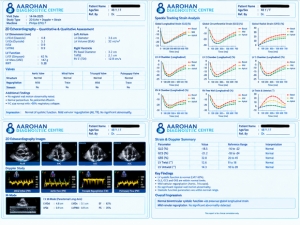
The pregnancy was identified as high-risk after the fetus was diagnosed with Congenital Pulmonary Airway Malformation (CPAM) involving the right lower lobe of the fetal lung during the 20-week pregnancy scan.
Following the diagnosis, the pregnancy was closely monitored to assess:
• CPAM size and progression
• Fetal growth and development
• Amniotic fluid volume
• Fetal Doppler parameters
• Signs of hydrops
• Mediastinal shift or compression
• Overall fetal wellbeing
The CPAM was diagnosed at approximately 20 weeks of pregnancy and was monitored closely with serial ultrasound and Doppler examinations until delivery at 37 weeks.
No fetal intervention was required. The pregnancy was managed conservatively with close antenatal surveillance, serial growth scans, CPAM assessment, and Doppler studies.
Congenital Pulmonary Airway Malformation (CPAM) involving the right lower lobe of the fetal lung, with later development of fetal growth restriction.
Serial ultrasound examinations and Doppler studies were performed throughout the pregnancy to monitor the CPAM, fetal growth, and fetal wellbeing.
At approximately 30+2 weeks, the ultrasound showed:
• Mixed cystic lesion involving the right lower lobe of the fetal lung
• One relatively larger cyst within the lesion
• CPAM volume of approximately 15.86 cm³
• CVR: 0.59
• No mediastinal shift
• No evidence of hydrops
• Normal amniotic fluid
• Normal fetal Dopplers at that stage
• Estimated fetal weight of approximately 1231 g
• Growth around the lower centiles with satisfactory interval growth
Conservative Management with Close Antenatal Surveillance
As there was no evidence of hydrops or significant mediastinal compression and the CPAM remained stable, fetal intervention was not required.
Duration: The pregnancy was monitored from approximately 20 weeks until 37 weeks.
Monitoring Approach Used
Regular growth scans
Serial CPAM assessment
Doppler studies
Umbilical artery Doppler monitoring
Assessment for hydrops
Monitoring of amniotic fluid
Close assessment of fetal growth and wellbeing
Up to 32 weeks, fetal growth remained satisfactory and Dopplers were reassuring. After 32 weeks, fetal growth restriction developed and the umbilical artery Doppler gradually showed increased resistance. Despite this, close surveillance allowed the pregnancy to continue safely to 37 weeks.
The pregnancy progressed successfully under close monitoring.
CPAM remained stable for most of the pregnancy.
No hydrops developed.
No significant mediastinal shift was observed.
Fetal growth was closely monitored.
Increased resistance in the umbilical artery was detected after 32 weeks.
Despite growth restriction, close Doppler and growth surveillance allowed pregnancy continuation to 37 weeks.
Interestingly, the CPAM lesion showed a reduction in size later in pregnancy.
A healthy baby boy weighing 2.2 kg was delivered.
The pregnancy resulted in the successful delivery of a healthy baby boy weighing 2.2 kg at 37 weeks, despite the antenatal diagnosis of CPAM involving the right lower lobe of the fetal lung and subsequent fetal growth restriction.
Returned to Normal Activities: Yes
This case demonstrates the importance of early diagnosis, individualized antenatal surveillance, and timely decision-making in a pregnancy complicated by fetal CPAM.
The lesion involving the right lower lobe of the fetal lung was detected during the 20-week pregnancy scan. The pregnancy was subsequently classified as high-risk and followed carefully with serial ultrasound examinations, growth scans, CPAM assessment, and Doppler studies.
Despite the development of fetal growth restriction and increased resistance in the umbilical artery Doppler after 32 weeks, close monitoring allowed the pregnancy to continue safely to 37 weeks.
Interestingly, the CPAM lesion also showed a reduction in size later in pregnancy, and the pregnancy resulted in the successful delivery of a healthy 2.2 kg baby boy.
The case involved:
• Antenatal diagnosis of CPAM at 20 weeks
• Right lower-lobe involvement of the fetal lung
• Serial assessment of the CPAM
• CPAM volume of approximately 15.86 cm³ at 30+2 weeks
• CVR of 0.59
• No hydrops
• No significant mediastinal shift
• Development of fetal growth restriction after 32 weeks
• Increasing resistance in the umbilical artery Doppler
• Continued close fetal surveillance
• Reduction in CPAM size later in pregnancy
• Successful delivery at 37 weeks
• Healthy baby boy weighing 2.2 kg
The most significant benefit was the successful continuation of a high-risk pregnancy through careful fetal surveillance and timely management, resulting in the delivery of a healthy 2.2 kg baby boy at 37 weeks.
This case highlights the importance of early detection, regular fetal assessment, individualized management, and timely decision-making in pregnancies complicated by Congenital Pulmonary Airway Malformation.
The CPAM involving the right lower lobe of the fetal lung was detected at the 20-week scan. The pregnancy was subsequently monitored closely with serial ultrasound examinations, growth assessments, CPAM measurements, and Doppler studies.
Although fetal growth restriction and increased resistance in the umbilical artery Doppler developed after 32 weeks, careful antenatal surveillance helped in assessing fetal wellbeing and determining appropriate management. The CPAM remained stable for most of the pregnancy and subsequently showed a reduction in size later in gestation.
The pregnancy was successfully continued to 37 weeks, resulting in the delivery of a healthy baby boy weighing 2.2 kg.
This case demonstrates how structured antenatal surveillance and individualized management can support favorable outcomes in selected pregnancies complicated by CPAM.